Part-of-speech tags — noun, verb, particle on every word | yomeru.ai
Every word is tagged as noun, verb, adjective, or particle. Conjugated forms show the base form alongside — 食べました maps back to 食べる.
Every word in yomeru.ai is automatically tagged with its grammatical role — noun, verb, adjective, particle, and so on. These tags appear in word popups alongside the definition, helping you understand not just what a word means but how it works in a sentence.
See it in action
Part-of-speech tags are visible in word popups and in the Sentence Analysis breakdown.
Common Categories
Here are the main grammatical categories you'll encounter, with examples:
| Tag | Japanese | Example |
|---|---|---|
| Noun | 名詞 | 本 (book) |
| Verb | 動詞 | 食べる (to eat) |
| i-adjective | 形容詞 | 大きい (big) |
| na-adjective | 形容動詞 | 静かな (quiet) |
| Particle | 助詞 | が, は, を |
| Adverb | 副詞 | とても (very) |
| Conjunction | 接続詞 | そして (and then) |
The distinction between i-adjectives (形容詞) and na-adjectives (形容動詞) matters because they conjugate differently. Knowing which type a word is saves you from making grammar mistakes.
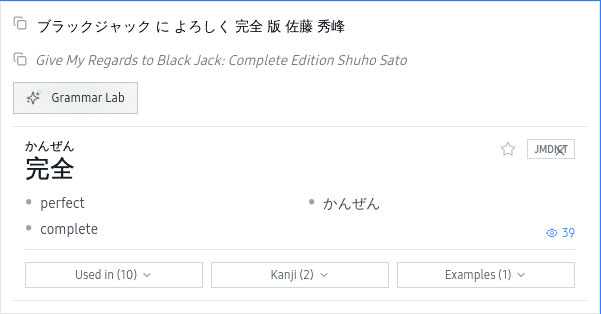 Part-of-speech tags appear in the word breakdown alongside readings and meanings
Conjugated Forms
When a verb or adjective appears in a conjugated form, yomeru.ai shows you both the form as it appears in the text and the base (dictionary) form. For example, if you encounter 食べました, the popup tells you the base form is 食べる and identifies the conjugation as past polite. This makes it much easier to look up unfamiliar conjugations.
Why This Matters
Understanding parts of speech helps you read faster. Once you can identify particles, you can quickly see how a sentence is structured. Once you know whether a word is a verb or a noun, you know what kind of conjugation rules (if any) apply. It's a small detail that compounds into a real advantage as you read more.
Related Pages
Automatic furigana — reading guides above every kanji | yomeru.ai
Furigana appears above every kanji automatically. Readings are context-aware, so 今日 shows きょう, not こんにち. Toggle off in display settings.
Word segmentation — Japanese text split into clickable words | yomeru.ai
Japanese has no spaces. The system splits continuous text into individual clickable tokens — nouns, particles, and conjugated verbs each become separate.