Word segmentation — Japanese text split into clickable words | yomeru.ai
Japanese has no spaces. The system splits continuous text into individual clickable tokens — nouns, particles, and conjugated verbs each become separate.
Japanese doesn't use spaces between words. A sentence like 今日は学校に行きました is written as one continuous string of characters — and figuring out where one word ends and the next begins is one of the biggest challenges for learners. yomeru.ai handles this automatically, splitting every text into individual, clickable words.
The foundation of everything
Word segmentation is what makes everything else possible — every word becomes interactive once boundaries are identified.
How It Works
Our system analyzes Japanese text and identifies word boundaries using a combination of dictionary matching and contextual analysis. The result is text that's broken into discrete, clickable pieces:
今日は学校に行きました becomes [今日] [は] [学校] [に] [行きました]
Each piece is now a word you can click to look up, see the reading for, or explore further. Particles like は and に are separated from the words around them, which helps you see the sentence's grammatical structure.
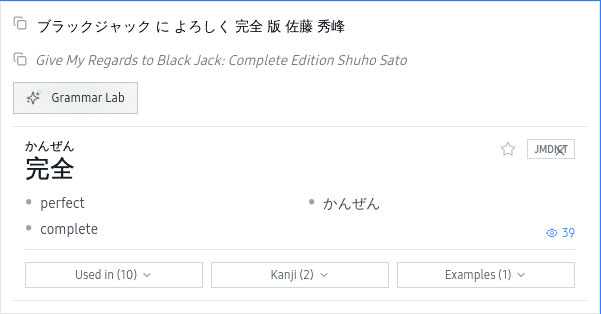 Each word is separated and tagged with its part of speech, making structure visible at a glance
Compound Words
For compound words like 日本語 (Japanese language), the system recognizes the full compound so you get the correct definition. You can also explore the individual kanji components (日本 + 語) from the word popup if you want to understand how the compound is constructed.
Accuracy
Word segmentation is highly accurate for standard written Japanese — news articles, novels, textbooks, and most manga. Results may vary slightly for heavy slang, very old Japanese, or unusual proper nouns, but these edge cases are rare in typical reading material.
You can see word segmentation in action through the Sentence Analysis feature.
Related Pages
Part-of-speech tags — noun, verb, particle on every word | yomeru.ai
Every word is tagged as noun, verb, adjective, or particle. Conjugated forms show the base form alongside — 食べました maps back to 食べる.
JLPT Sim — timed practice tests for N5 to N1 | yomeru.ai
Full JLPT practice exams with timed sections, listening audio, authentic question formats, scored results, and free retakes. All five levels.