Learn Japanese with manga — complete reading guide | yomeru.ai
Shuhei Nakamura
2026/02/05
Updated: 2026/02/22

Manga is one of the most effective ways to learn Japanese—pictures carry the story while you focus purely on dialogue. But without the right tools, looking up every unknown word kills the fun. This guide covers how to pick manga for your level, read with OCR, and build vocabulary from what you actually enjoy reading.
| Your Level | Start With |
|---|---|
| Complete beginner | Crystal Hunters (87 unique words) |
| N5-N4 | Yotsuba&!, Shirokuma Cafe, Blue Box |
| N3+ | Horimiya, One Piece, Death Note |
Why Manga Works for Learning Japanese
Manga has one massive advantage over books and textbooks: pictures. In a novel, you'd spend paragraphs reading about a medieval cityscape with cobblestone streets and looming castles. In manga, you simply see it and move on.
This visual context carries the story, letting you focus entirely on dialogue coming out of characters' mouths. Manga aligns with what research on comprehensible input consistently shows -- learning through engaging content outperforms traditional instruction.
Key benefits of learning Japanese through manga:
- Shorter sentences — Speech bubbles force concise dialogue, unlike dense paragraphs in novels
- Context clues everywhere — Facial expressions, actions, and backgrounds fill gaps in comprehension
- Natural conversation patterns — You learn how Japanese people actually talk, not textbook formality
- Built-in motivation — Reading stories you enjoy beats drilling vocabulary lists
- 80/20 efficiency — The 2,000 most frequent words cover 80% of text, and manga exposes you to these naturally
The Knowledge Gap: What Stands Between You and Fluent Reading
Between you and fluent manga reading stands a significant knowledge gap: a few thousand vocabulary words, at least a few hundred kanji, and Japanese grammar including particles. Most learners face a frustrating cycle:
- Encounter unknown kanji
- Try to draw it by hand in a lookup app
- Fail because stroke order matters
- Finally find the reading after 3 minutes
- Forget what was happening in the story
Without OCR (optical character recognition) software, looking up a single word can take minutes—especially when you don't know how to pronounce a kanji. This friction turns reading practice into a tedious exercise.
The Foreign Service Institute classifies Japanese as a Category IV language, estimating 2,200 hours to reach professional proficiency for English speakers. But with the right tools and immersion approach, realistic timelines look like:
- Basic conversational ability: 6-12 months of consistent daily immersion (2-3 hours per day)
- Intermediate fluency: 1.5-2 years — read manga with occasional lookups, understand most anime
- Advanced fluency: 3-4 years — consume most native content comfortably
Reading Manga with OCR
Upload a manga page to Yomeru.ai and the AI detects speech bubbles, extracts text, segments words, and identifies conjugations. Click any word for word lookups with readings and example sentences. For a full feature review, see our reading tools roundup.
When you encounter わかった in a speech bubble, you don't need to know how to type it. Yomeru.ai recognizes the text, breaks it down (分かる → 分かった, past tense of "to understand"), and shows you the word entry in one click.
Choosing Manga for Your Japanese Level
The right manga makes all the difference. Natively, a community-powered difficulty ranking platform, uses an Elo-based system from thousands of user comparisons to grade Japanese content. Here's how their levels map to JLPT:
| Natively Level | JLPT Equivalent | Recommended Manga |
|---|---|---|
| L0-12 | ~N5 | Crystal Hunters, Graded readers |
| L13-19 | ~N4 | Yotsuba&! (L17), Shirokuma Cafe, Flying Witch |
| L20-26 | ~N3 | Horimiya, Nichijou, One Piece |
| L27-33 | ~N2 | Death Note, Attack on Titan |
Absolute Beginner: Crystal Hunters
Crystal Hunters is a fantasy manga intentionally written for Japanese learners. The first book contains only 87 unique words, with a free guide teaching all the Japanese you need to read it. It comes in two versions: simplified "Japanese" for beginners and "Natural Japanese" for those ready for more authentic language.
Beginner Recommendations (N5-N4)
Yotsuba&! (よつばと!) — The everyday adventures of a young girl and her father. Rated Level 17 on Natively (upper beginner). Uses simple vocabulary and daily life situations, but be aware: it contains casual grammar that textbook learners may find challenging initially.
Shirokuma Cafe (しろくまカフェ) — Light-hearted stories about a polar bear running a cafe. N4 level with dry humor and simple dialogue.
Doraemon — A classic with repetitive vocabulary and grammar patterns. The episodic format means you can read one chapter without needing prior context.
Blue Box (アオのハコ) — Sports romance manga serialized in Weekly Shonen Jump. N5-N4 level with everyday vocabulary.
Teasing Master Takagi-san (からかい上手の高木さん) — Sweet schoolyard story at high N4/low N3 level with furigana throughout.
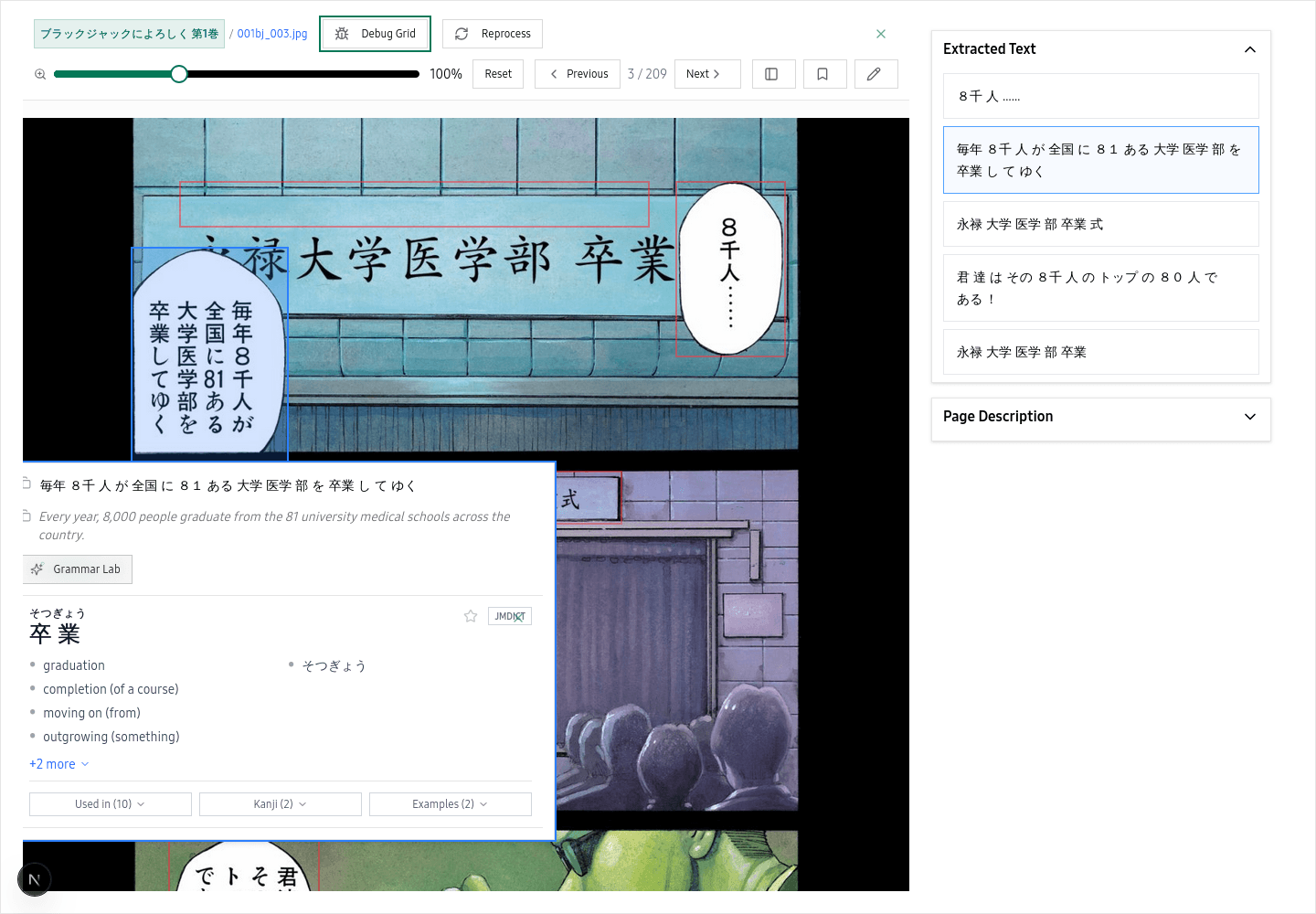 Click any word on the page for instant readings, meanings, and grammar tags
Intermediate Recommendations (N3+)
Horimiya (ホリミヤ) — Romance with interesting vocabulary and slang, plus cultural insights.
Natsume's Book of Friends (夏目友人帳) — Supernatural slice-of-life with varied vocabulary.
The Way of the Househusband (極主夫道) — Comedy about a former yakuza becoming a househusband. Great for slang and casual speech.
One Piece (ワンピース) — The shonen classic mixes simple and complex language, challenging learners to level up.
Choosing Difficulty Rules
- Pass the vibe check — Pick something you find at least somewhat interesting
- Check vocabulary density — With Yomeru.ai, a few unknown words per speech bubble is fine. Without tools, aim for 4 unknown words or fewer per page
- Apply the 80/20 rule — Target understanding 80% through context and visual clues, only looking up words that prevent basic story comprehension
- Stick to simple genres first — Master slice-of-life vocabulary before tackling fantasy or sci-fi
How to Use Yomeru.ai for Manga Reading
- Upload your manga page -- Drag and drop any image: screenshots, scans, or photos of physical books
- Click any word -- The AI detects text regions, and a popup shows word entries with readings, meanings, and grammar breakdowns
- Save words to study -- Build vocabulary lists from your actual reading material
- Keep reading -- Lookups are fast enough to stay immersed in the story
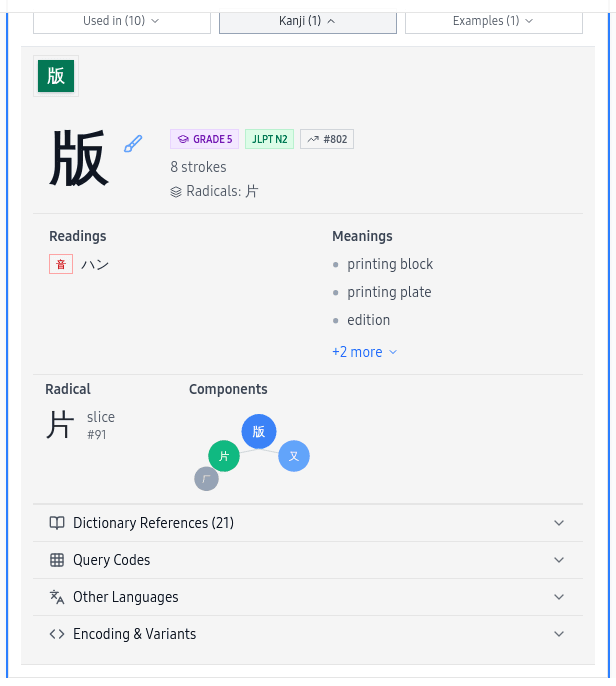 Tap any kanji to explore its readings, radicals, stroke order, and common compounds
Mastering Casual Japanese in Manga
Even with the right tools, manga presents unique challenges. Real speech is messy—characters use contracted forms, drop particles, and speak in fragments that textbooks never cover.
Common Contractions
| Formal | Casual | Example |
|---|---|---|
| ている | てる | 食べている → 食べてる |
| ない | ねえ | わからない → わからねえ |
| すごい | すげえ | すごい → すげえ |
| これはなに | これなに | Particle dropping |
Pro tip: Reading dialogue aloud helps. Many casual forms are contractions that make more sense when you hear them spoken—they're shortened because they're easier to say quickly.
Fragmented Sentences
Real speech is incomplete. Characters trail off, interrupt each other, and speak in fragments that depend heavily on visual context. Rather than complete sentences, you'll see partial thoughts. Context is everything.
The Yotsuba Trap
Despite its recommendation as beginner-friendly, Yotsuba&! uses extensive casual grammar that textbook learners (Genki, Minna no Nihongo, Duolingo) have almost no experience with. Additionally, the lack of kanji in child speech can make word parsing harder—learners often find it easier to recognize 食べる than たべる.
Yomeru.ai's smart text analysis helps here by automatically identifying word boundaries even in hiragana-heavy text.
Intensive vs. Extensive Reading: Balance Both
Effective language acquisition benefits from both reading strategies:
Intensive Reading:
- Carefully read shorter texts with high comprehension
- Look up unknown vocabulary and grammar
- Aim for near-perfect understanding
- Best for: detailed grammar study, building precision
Extensive Reading:
- Read longer texts for general understanding
- Focus on quantity over perfection
- Target 85-95% comprehension
- Best for: building fluency, natural acquisition
The Optimal Approach
- First pass (extensive): Read without stopping to look up every word. Get the general idea from pictures and familiar vocabulary.
- Second pass (intensive): Go back and look up words that matter for story comprehension.
- Third pass (reinforcement): Re-read with your notes. Notice how much easier it flows.
This mirrors the comprehensible input principle: optimal acquisition occurs when input is slightly beyond your current level (i+1) but remains comprehensible through context.
Sentence Mining: Building Vocabulary from Manga
Sentence mining—creating flashcards from your immersion content—is more effective than premade vocabulary decks because every card has personal context attached.
Why Mining Works
- Reinforcement: Reviewing vocabulary from content you enjoyed improves retention
- Relevance: You learn words that actually appear in what you read
- Context: Full sentences preserve grammar patterns and natural usage
- Memory hooks: You remember where you found the word and what was happening
Best Practices
- Wait until you know ~1,000 words before mining (otherwise everything is new)
- Include the full sentence, not just isolated words
- Add the manga panel image for visual memory
- Focus on 5-10 high-quality cards per reading session
- Use Yomeru.ai's word lists to track what you're learning
For a full breakdown of Anki and other review tools, see our reading tools roundup.
For a detailed comparison of manga reading tools, see our reading tools roundup. For a specific comparison with Mokuro, see Yomeru.ai vs Mokuro.
Frequently Asked Questions
Start Reading Manga Today
Pick a manga at your level from the table above, open it with a reading tool, and start. You don't need thousands of kanji or perfect grammar -- you need a source and a way to look things up.
Written by
Shuhei Nakamura
Japanese Language Educator
A Japanese language educator with over 15 years of teaching experience, Shuhei specializes in reading-focused approaches to language acquisition. Drawing from his background in applied linguistics and immersive learning methods, he writes about practical strategies that help learners build real fluency through extensive reading and native content.