How AI-assisted reading unlocks authentic Japanese earlier | yomeru.ai

Shuhei Nakamura
2026/01/04
Updated: 2026/02/22

AI reading tools let you start reading authentic Japanese—manga, novels, news—months earlier than the traditional textbook-first path. Instead of grinding vocabulary lists until you're "ready," you read real content now and learn from context, with smart assistance filling the gaps.
The intermediate plateau exists because learners wait too long to read native materials. The fix is simple: start reading earlier with better tools.
The Case for Reading Authentic Content Early
Why does reading native content matter so much? Research on vocabulary acquisition shows words need 10-20 encounters in varied contexts before moving into active vocabulary. When you encounter 犬 in manga—first in 犬が好き, later in 野良犬, eventually in 犬小屋—you build neural connections that make the word stick naturally.
Flashcards can provide repetition, but they struggle to provide varied, meaningful context. Reading authentic content provides this automatically. You encounter words in situations that matter, attached to stories you care about.
The psychological benefit matters too. Engaging with content you genuinely enjoy—manga you've wanted to read, novels by authors you admire—sustains motivation in ways textbook exercises never can.
The tadoku extensive reading method builds on this principle—massive volume of enjoyable reading.
What AI Reading Assistance Actually Provides
Modern AI reading tools go far beyond simple dictionary lookups. Here's what they offer:
Conjugation breakdowns — Japanese stacks grammatical meaning into single verb forms. When you encounter 食べられなかった, AI tools break it into 食べる (eat) + られる (potential) + ない (negative) + た (past) = "couldn't eat." You see the logic instead of guessing.
Word segmentation — Japanese has no spaces. A sentence like 昨日友達と映画を観に行った is a single unbroken string to untrained eyes. AI tools segment it into 昨日 / 友達 / と / 映画 / を / 観に行った so you can look up each piece and understand the structure.
Example sentences in context — When you encounter 気になる, a definition ("to be on one's mind") only goes so far. Seeing it in five different sentences—a character worrying about test results, noticing someone attractive, wondering about a noise—teaches the range of nuance a single definition cannot.
Context-aware definitions — 上がる means "to rise" but which kind? AI tools give you "prices rose" (物価が上がった) in a news article and "went upstairs" (二階に上がった) in a novel, matching the definition to the sentence you are actually reading.
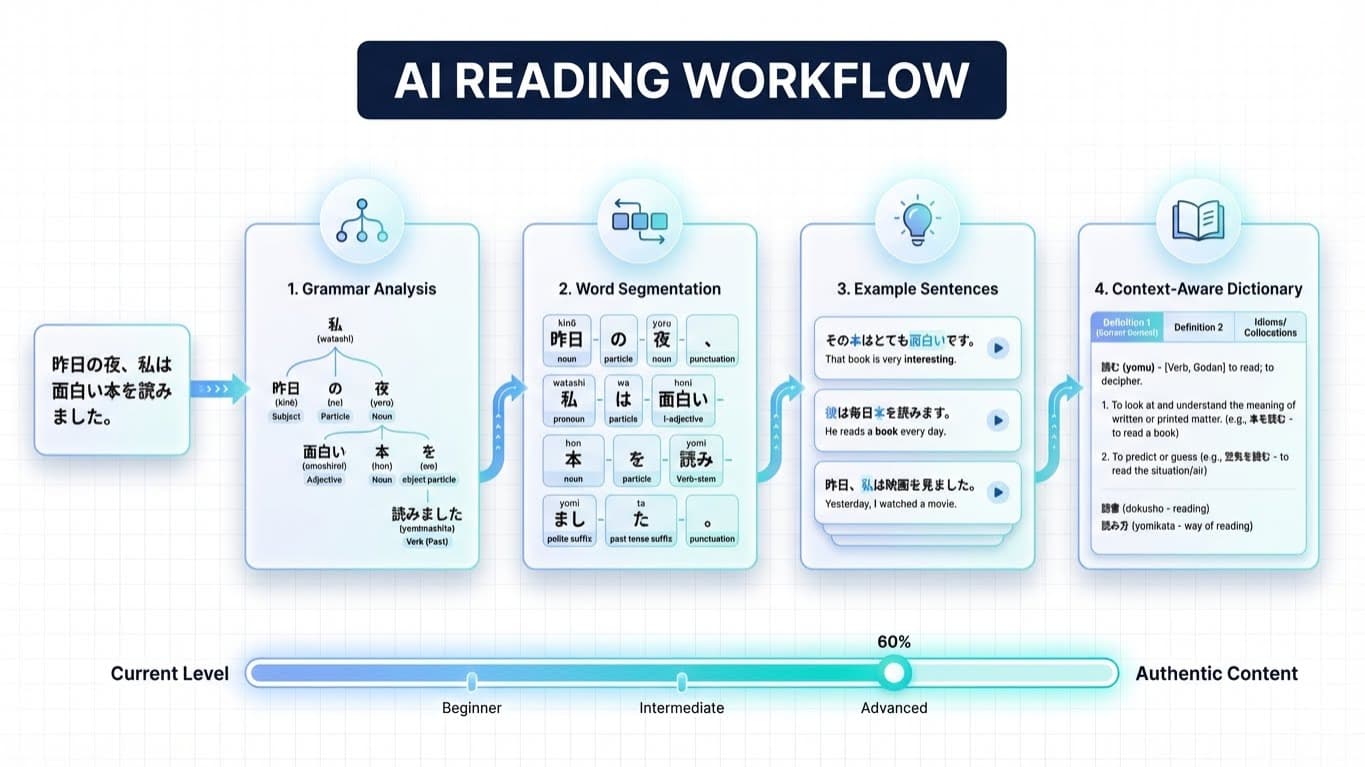 Smart reading tools bridge the gap between your current level and authentic content
How Japanese Nuance Defeats Dictionary-Only Learning
Consider 見る (to see/look/watch). Same sound (miru), different kanji, different nuances:
- テレビを見る — casual viewing
- 映画を観る — appreciative watching
- 医者に診てもらう — medical examination
- 病人を看る — caregiving observation
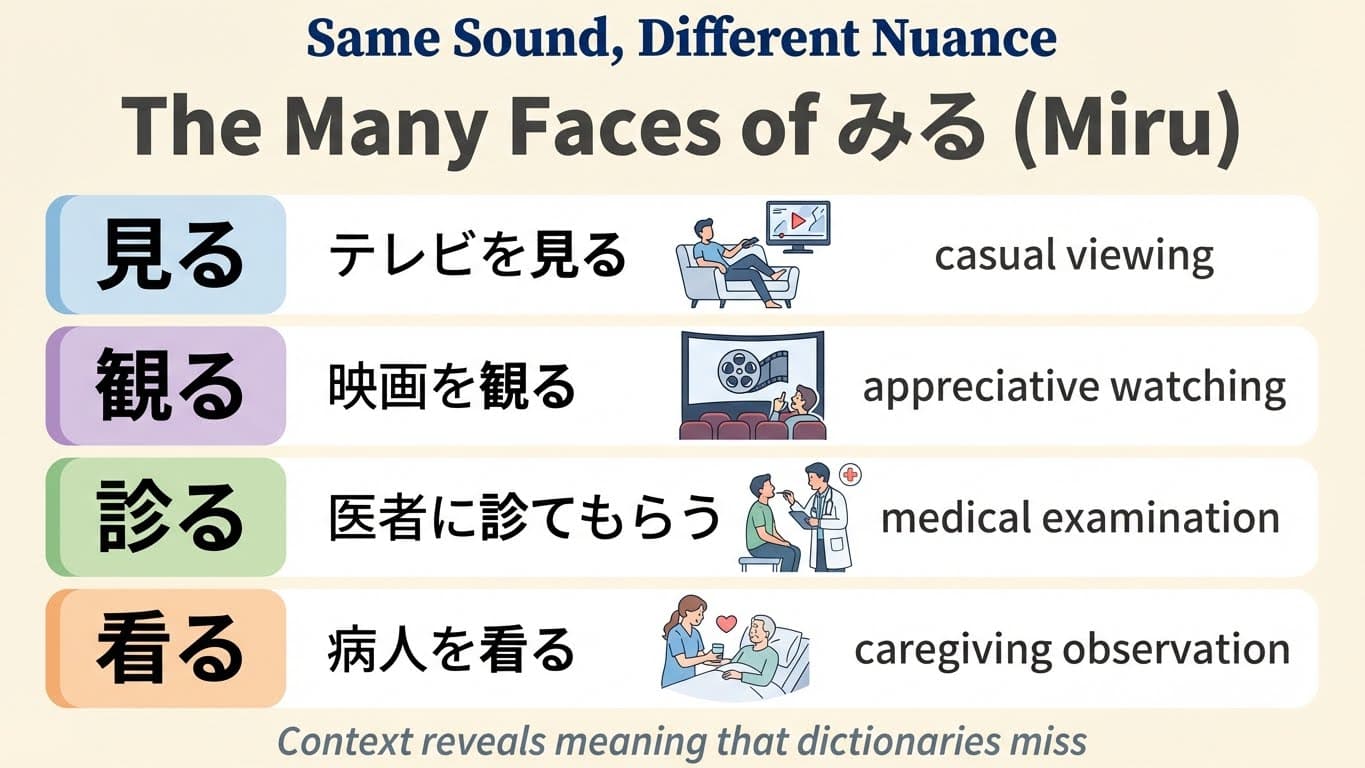 Same pronunciation, completely different nuances—learned through context
A dictionary provides definitions. Only repeated exposure in natural context teaches when native speakers choose which form.
Japanese packs nuance into features absent from most languages: particle selection (水が飲みたい vs 水を飲みたい), formality levels (食う → 食べる → 召し上がる), and emotional vocabulary precision (切ない, 物寂しい, 懐かしい).
When you encounter は vs が in hundreds of natural contexts, your brain builds intuitive usage maps that conscious study cannot replicate. AI tools that explain these nuances as you encounter them accelerate this pattern recognition dramatically.
The Reading-Listening Connection
Many learners ask: reading or listening first? Reading builds the vocabulary and pattern recognition that makes listening comprehension possible. Adult brains need visual reinforcement to connect sounds with meanings.
The "learn like a baby" approach has a critical flaw: babies spend 12-18 months in intensive listening before producing single words. Adults lack that time and lack developing brains wired for first language acquisition. Adults learn most efficiently by leveraging existing literacy skills.
Japanese intensifies this challenge:
- Homophones everywhere — こうこう alone has five common meanings: 高校 (high school), 孝行 (filial piety), 口腔 (oral cavity), 硬膏 (adhesive plaster), 工巧 (craftsmanship). Without kanji, audio is ambiguous.
- Particle ambiguity — は and わ sound identical but function completely differently
- Pitch accent — Changes meaning but remains nearly invisible to non-native ears initially
Reading provides visual anchors—kanji, grammar structure—that make audio comprehensible. AI tools that show furigana, pitch accent markers, and pronunciation support this reading-listening bridge.
A Practical Reading Workflow
Step 1: Choose Content You Care About
Pick manga, novels, or articles you genuinely want to read. Motivation matters more than "appropriate level" when AI tools bridge vocabulary gaps. Fighting through content you don't enjoy kills consistency.
For finding content, see our guide to Japanese sources.
Step 2: Use AI-Assisted Reading Tools
Upload images, paste text, or photograph physical pages. Modern tools process content instantly and provide comprehensive analysis.
Step 3: Read Strategically
Click words needed for comprehension. Let less critical vocabulary pass—you'll encounter it again. Focus on understanding the story, not capturing every word.
Step 4: Integrate Listening
After reading a manga chapter, watch the anime adaptation. Written vocabulary becomes instantly recognizable in audio. This reinforcement builds both skills simultaneously.
Building from Manga to Literature
For manga recommendations matched to JLPT level with Natively difficulty ratings, see our manga reading guide.
Foundation (3-6 months):
- よつばと! — Clear dialogue, daily life vocabulary
- ちいかわ — Simple contemporary Japanese
Intermediate (6-12 months):
- 「コンビニ人間」by 村田沙耶香 — Modern prose
- 「キッチン」by 吉本ばなな — Contemporary, accessible
Advanced (12+ months):
- 「ノルウェイの森」by 村上春樹 — Modern literary style
- 「雪国」by 川端康成 — Poetic, cultural depth
Reading at 70-80% comprehension builds competence faster than reading only material you understand 100%. AI assistance makes this level of challenge manageable rather than frustrating.
Frequently Asked Questions
Pick something you want to read and start. The tools handle what you don't know yet; consistent reading handles the rest.
Written by
Shuhei Nakamura
Japanese Language Educator
A Japanese language educator with over 15 years of teaching experience, Shuhei specializes in reading-focused approaches to language acquisition. Drawing from his background in applied linguistics and immersive learning methods, he writes about practical strategies that help learners build real fluency through extensive reading and native content.