Immersion works. AI fixes the part that breaks it. | yomeru.ai

Shuhei Nakamura
2026/05/02
Updated: 2026/05/02
Real Japanese input does the learning. AI does not.
That is the first rule. It keeps the whole system honest.
The best AI tools for Japanese are not replacement teachers, replacement immersion, or magic fluency engines. They are friction reducers. They help you stay inside the loop that already works: read or listen to real Japanese, look up what blocks comprehension, mine what is worth keeping, review it, and go back to the content.
The old mistake was waiting until you were "ready" before touching native material. The new mistake is asking AI to become the native material. Both mistakes keep you away from the thing that matters: thousands of encounters with real Japanese, written and spoken by real people, in contexts that were not designed to flatter your current level.
The Method Has Not Changed
TheMoeWay Japanese Guide gets the central point right: the learner has to move into real input. Grammar study, vocabulary decks, and dictionaries all help, but they are support systems. They are not the mountain.
For reading, the practical loop is simple:
- Read real Japanese.
- Look up only what matters.
- React to the sentence in context.
- Keep reading.
- Mine useful words or patterns into Anki.
- Review them later.
- Return to more input.
This is not glamorous. It is not complicated. It is also where most learners break.
The breaking point is not philosophy. It is logistics. A sentence gets difficult, the lookup chain becomes five tabs deep, the learner loses the scene, and the reading session quietly turns into grammar archaeology. Ten minutes later the manga page is still open, but the actual reading is dead on the table.
AI earns its place only if it prevents that death.
Where the Loop Breaks
Imagine you are reading and hit this sentence:
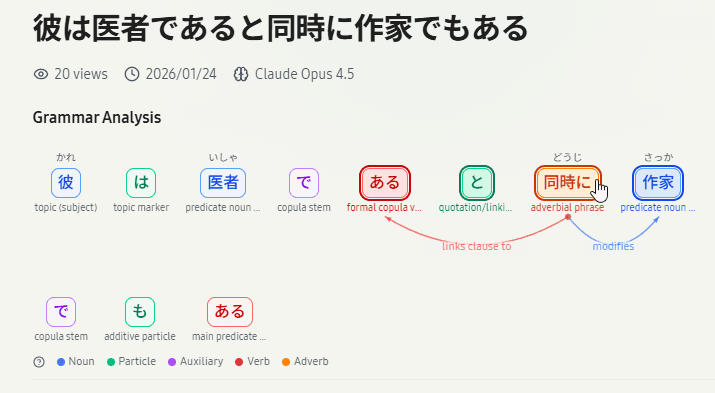
彼は医者であると同時に作家でもある
You may know the words:
- 彼: he
- 医者: doctor
- 作家: writer
But the sentence still has machinery inside it. The meaning depends on how である, と同時に, and でもある work together. A dictionary can give fragments. A grammar site can explain と同時に. A textbook can explain formal copulas. Anki can help you remember the pattern later.
The problem is that the live reading moment needs an answer now. Not a full lecture. Not a rabbit hole. Just enough structure to make the sentence readable and keep the session moving.
This is the precise job for AI.
Grammar Lab in the Loop
Grammar Lab turns a hard sentence into structure: words, particles, predicates, and the grammar relationship between them
In Yomeru.ai Grammar Lab, the sentence is analyzed as a formal written pattern:
であるis the formal written copula, roughly the elevated version ofだ.と同時にlinks the first identity to the second: "at the same time as" or "while also being."でもあるadds the second identity withも, giving the "also is" force.
So the sentence is not just "he doctor same time writer." It is:
He is a doctor and at the same time also a writer.
More importantly, the structure is reusable. You are not only translating one sentence. You are learning a pattern:
Aであると同時にBでもある
That pattern appears in essays, profiles, news, formal introductions, and literary description. Once you see it cleanly, the next encounter costs less.
That is acceleration. Not skipping the work. Making the next repetition cheaper.
The AI Job Description
AI should do three jobs in a Japanese learning workflow.
First, preserve reading flow. When a sentence blocks you, AI should explain just enough grammar, nuance, and vocabulary to return you to the page. The goal is not to admire the explanation. The goal is to keep reading.
Second, connect grammar to real context. Grammar learned in isolation goes stale quickly. Grammar seen inside a sentence you actually cared about has hooks. If you meet と同時に in a character description, it is no longer an abstract N2 item. It is part of how Japanese introduces simultaneous roles or qualities.
Third, improve mining decisions. Not every unknown word deserves an Anki card. Not every grammar point needs a full note. AI can help identify what is load-bearing: the target pattern, the sentence meaning, the register, and the part worth reviewing.
That is enough. Asking AI to become the whole method is where the wheels come off.
A Practical Workflow
Use this loop when reading manga, novels, articles, visual novels, or any other real Japanese content.
1. Read first. Try the sentence before opening any tool. Even a wrong guess is useful because it tells you what your brain expected.
2. Analyze only the blocker. If one grammar pattern is stopping comprehension, send that sentence to Grammar Lab. Do not turn every sentence into a research project. A lookup tool that stops you from reading has failed its assignment.
3. Extract the reusable piece. For the example sentence, the reusable piece is not just 医者 or 作家. It is the pattern Aであると同時にBでもある, plus the formal register.
4. Mine the sentence if it is worth seeing again. Add an Anki card only if the sentence is clear, useful, and likely to help future reading. Good cards come from real encounters, not from panic.
5. Review later, not now. Anki is for review time. Reading time is for reading. The distinction matters because every tool wants to steal the whole session and call it productivity.
6. Return to input. The next page is the point.
For a broader reading-tool stack, see our reading tools roundup. For the earlier argument on starting authentic content sooner, see how AI-assisted reading unlocks authentic Japanese content. And if you already work in an AI coding agent, you can pipe the same Grammar Lab and Word Lab data straight into it via our Japanese Language MCP — no API keys, no auth, just JSON.
What to Put in Anki
The strongest Anki cards come from your actual reading. A good mined card for the sentence above might include:
- The original sentence:
彼は医者であると同時に作家でもある - The target pattern:
Aであると同時にBでもある - A short meaning: "while being A, also B"
- The source context: where you found it
- One note on register: formal or written
Do not make the card huge. Do not paste an entire AI essay into the back. If the card takes more effort to review than the original sentence took to read, the bureaucracy has beaten the language. Happens to empires. Happens to Anki decks.
AI-generated examples can be useful as supplements, especially when you need to compare similar forms. But your primary cards should come from native material you encountered yourself. Real context is the anchor. Generated context is training wheels.
What AI Does Not Replace
AI does not replace input volume. You still need hundreds and then thousands of pages, episodes, conversations, and repeated encounters. A perfect explanation of と同時に does not equal acquiring it. Acquisition comes when the pattern keeps appearing until it stops feeling like a pattern and starts feeling like Japanese.
AI does not replace dictionaries. For word meanings, readings, kanji, and fixed expressions, dictionaries still matter. AI is useful for disambiguation and explanation, but it should not become your only source of truth.
AI does not replace Anki. Reviewing mined vocabulary is boring because retention work is often boring. That is not a software failure. That is memory being memory.
AI does not replace partial comprehension. You will still read things you only half understand. Good. That discomfort is not a bug in immersion. It is the price of admission.
The learner who tries to eliminate all uncertainty before continuing will always be slower than the learner who understands enough, marks what matters, and keeps moving.
A 30-Minute AI-Assisted Session
Here is what this looks like without ceremony:
- 20 minutes reading manga, a light novel, news, or a visual novel.
- 5 minutes using Grammar Lab only on sentences that genuinely block comprehension.
- 3 minutes mining one or two useful cards into Anki, with a short register note if it matters.
- 2 minutes reviewing yesterday's mined cards.
Then stop. Tomorrow, do it again.
This workflow is not trying to make Japanese easy. It is trying to keep the difficulty pointed in the right direction. You should spend your effort on real Japanese, not on the administrative hell of managing lookups across six tabs and a half-broken note template.
Do Not Stay Behind
The serious learners in 2026 are not choosing between immersion and tools. That framing is old. The real question is whether the tools keep them closer to real input or pull them away from it.
Use the latest tools when they compress friction:
- OCR for manga and scans.
- Grammar Lab for sentence structure.
- Word Lab and dictionaries for vocabulary.
- Anki for mined review.
- Native content for the actual learning.
That is the stack. Not AI instead of immersion. AI inside immersion.
The method works. The tools remove drag. The hours still have to be paid.
Written by
Shuhei Nakamura
Japanese Language Educator
A Japanese language educator with over 15 years of teaching experience, Shuhei specializes in reading-focused approaches to language acquisition. Drawing from his background in applied linguistics and immersive learning methods, he writes about practical strategies that help learners build real fluency through extensive reading and native content.